Launch offer — valid today only

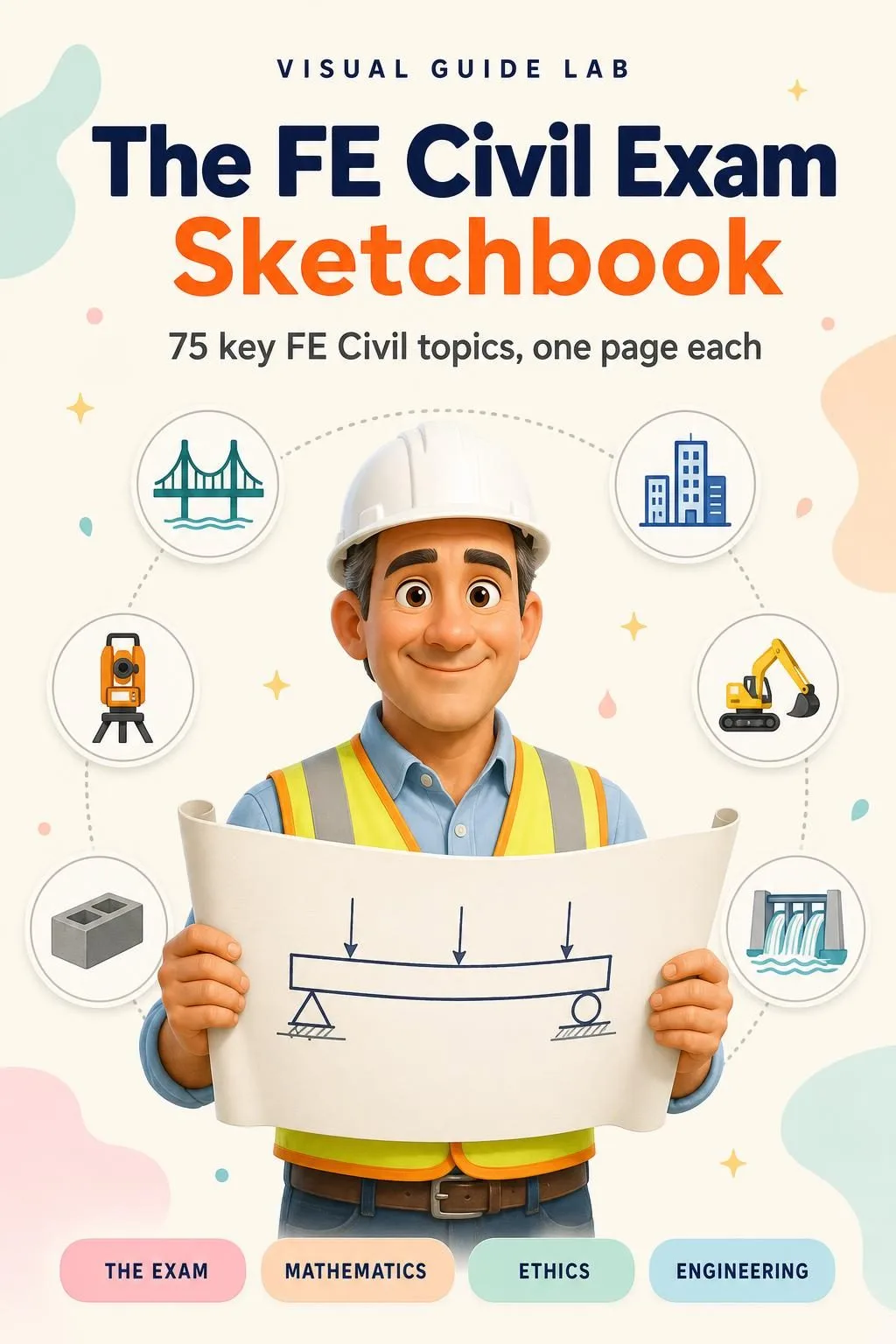
FE Civil Exam: 75 Topics, One Page Each The Drawing First, Then Every Calculation Line by Line

Free-body diagrams, shear and moment, Mohr's circle, cash flows, Manning, effective stress, vertical curves and critical path: in your notes, a wall of text. Here each topic fits on one page: draw it, find it in the Handbook, solve it, always in the same order. 80 drawn pages.

I WANT TO STUDY WITH DRAWINGS

🔒 Secure checkout · PDF by email · 30-day guarantee

One topic per page3 steps, same order every time: draw it, find it in the Handbook, solve it
80 drawn pages16 parts: the 14 FE Civil knowledge areas, plus how the exam works and a final review
Up-to-date sourcesNCEES FE Civil specification and FE Reference Handbook

This Is What the Pages You Will Study Look Like

One topic per page, the drawing that shows you how it's done, and the boxes with what you need to know:

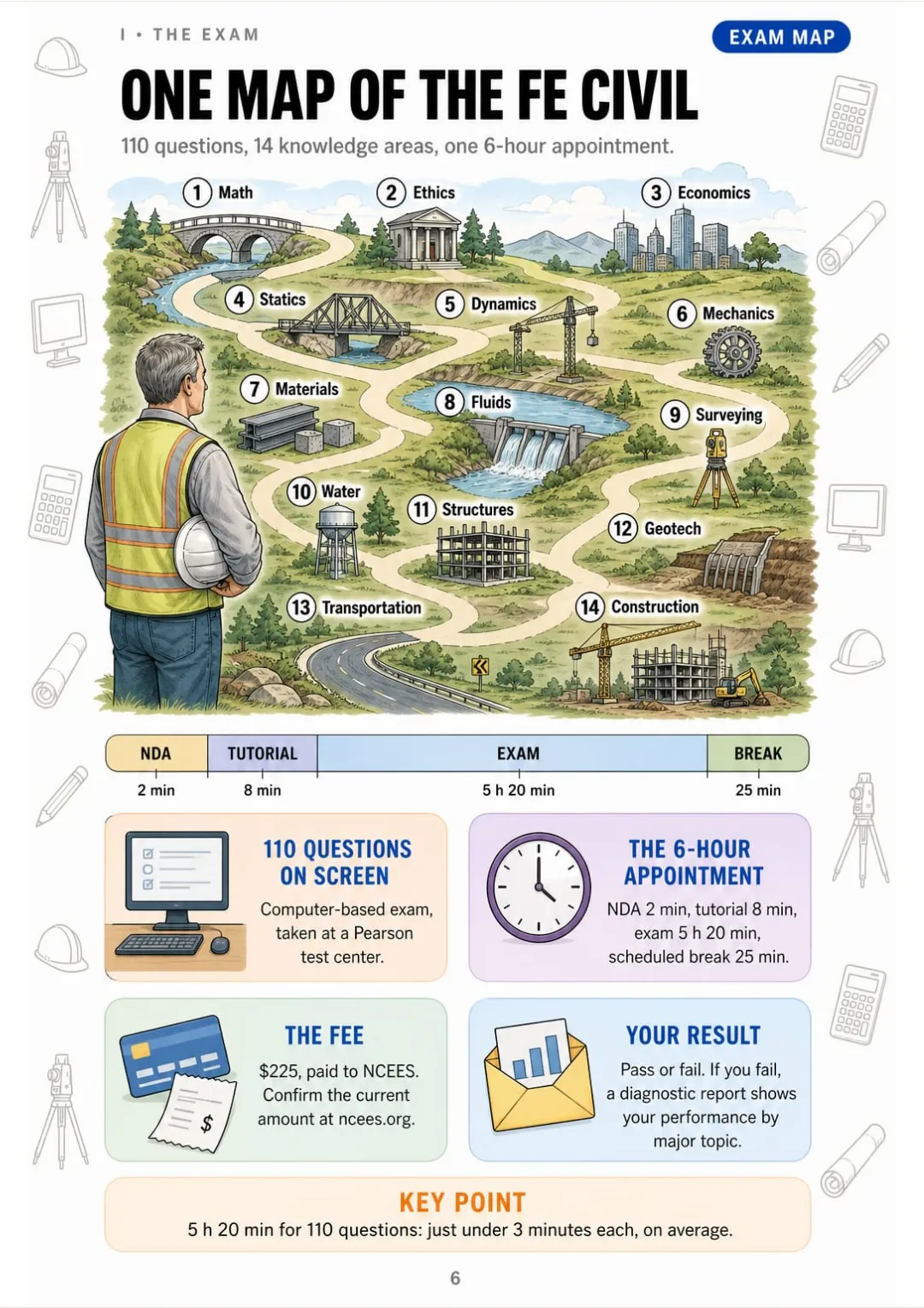
110 questions, 14 knowledge areas and a 6-hour appointment, all on one page.
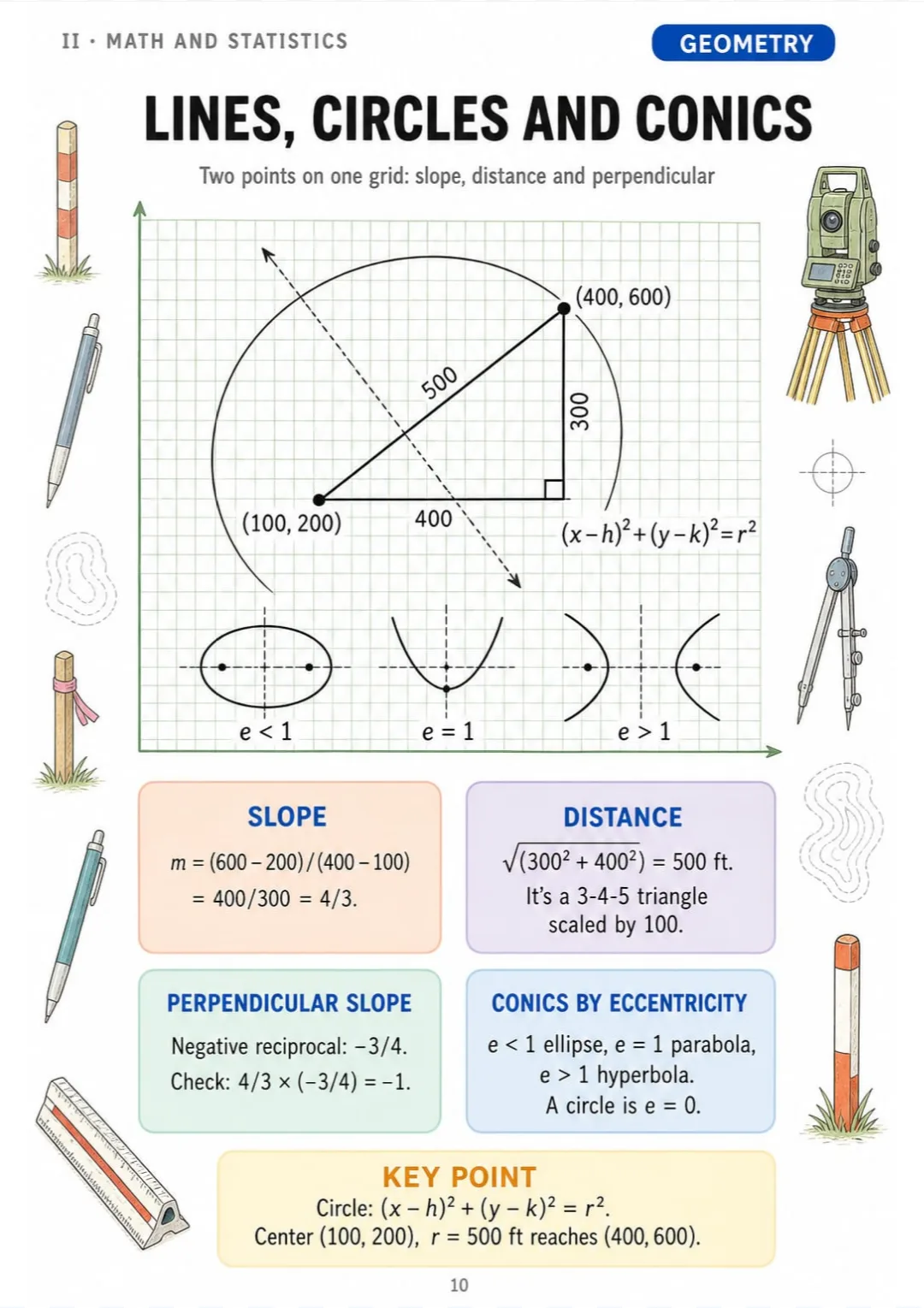
Points (100, 200) and (400, 600) ft: slope 4/3, distance 500 ft, perpendicular slope −3/4.
Four checks from the NCEES Model Rules, worked on a pressured drawing sign-off.
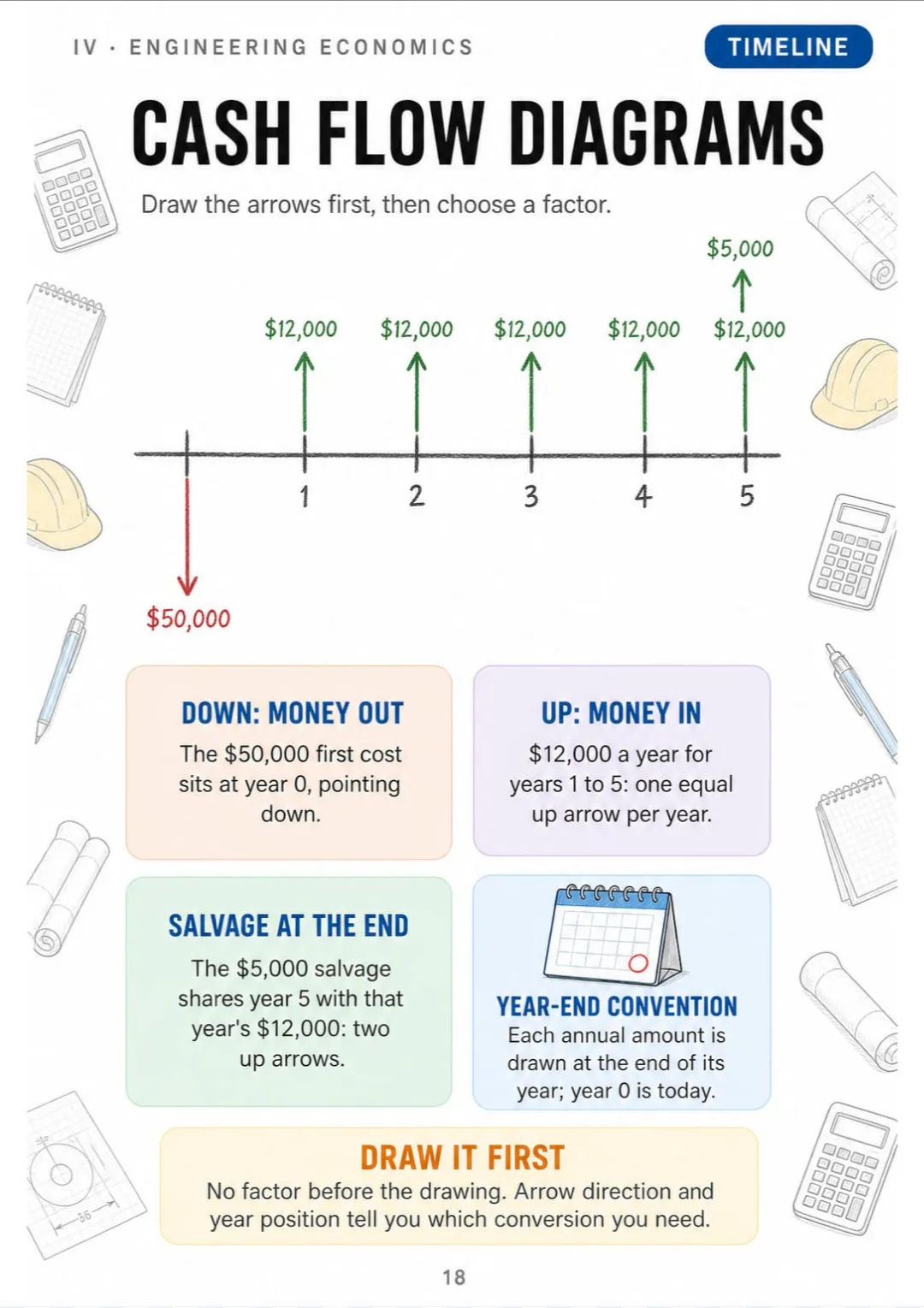
$50,000 down at year 0, $12,000 up in years 1 to 5, $5,000 salvage at year 5.
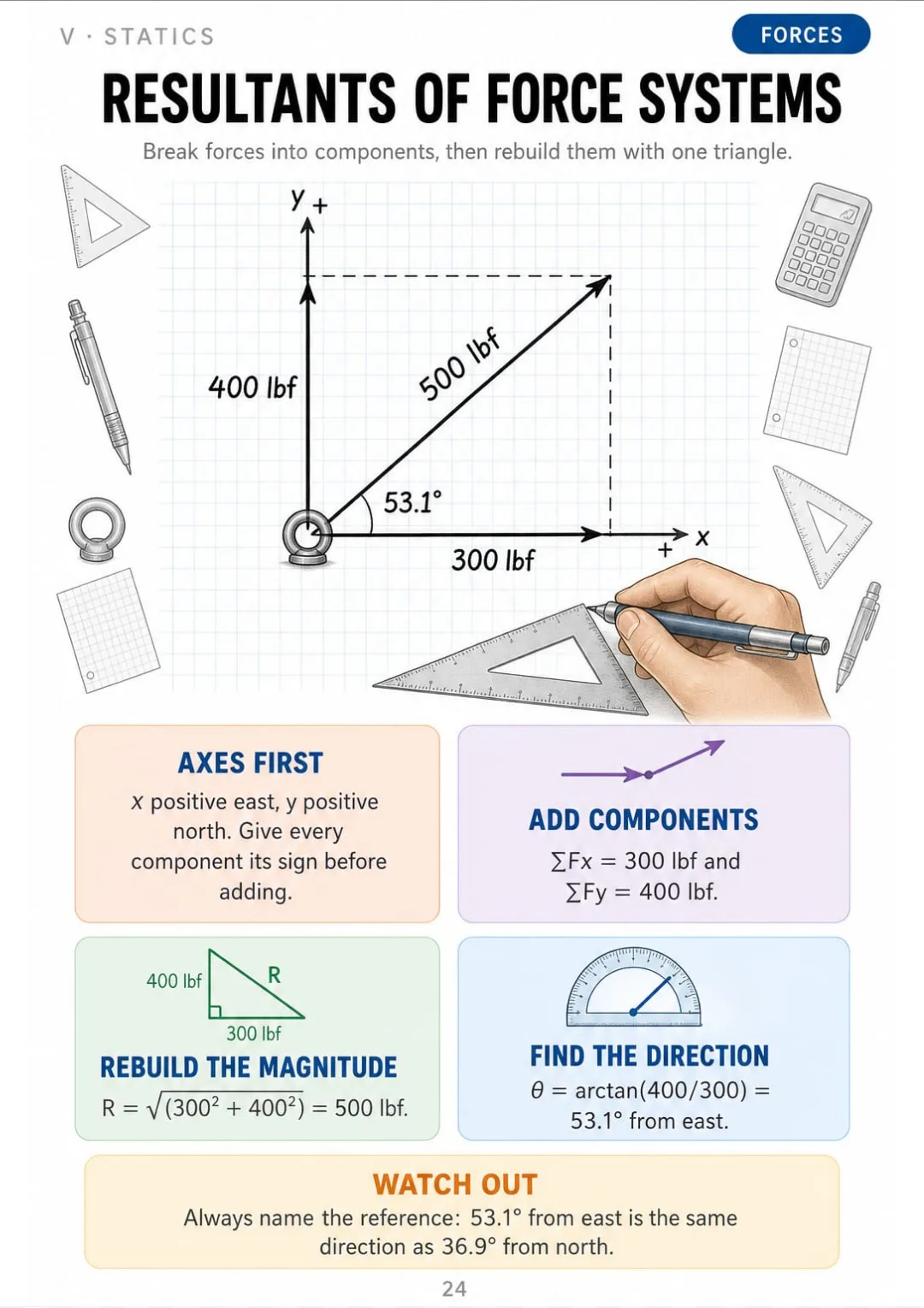
300 lbf east + 400 lbf north = 500-lbf resultant at 53.1° from east.
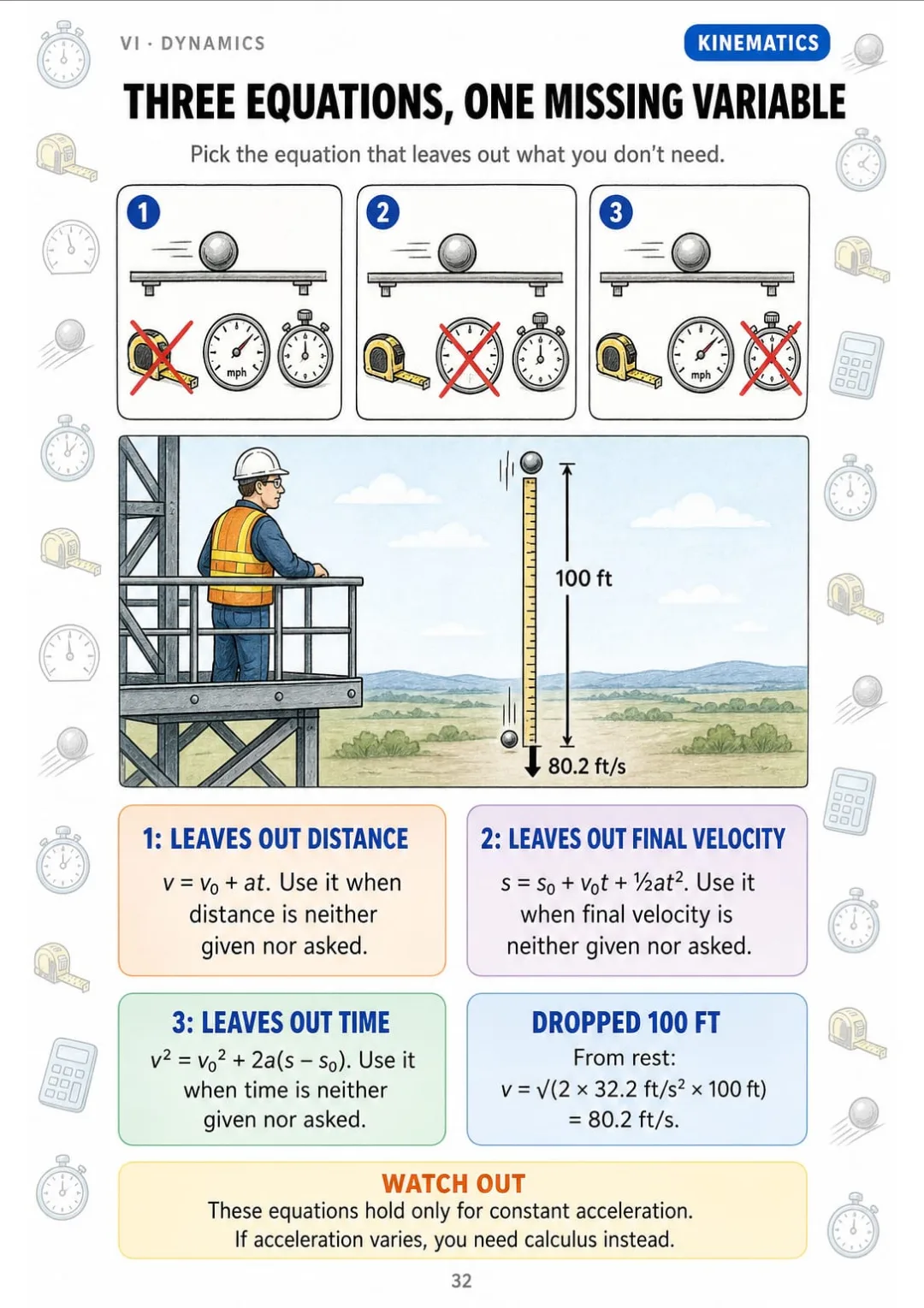
Dropped 100 ft from rest: v = √(2 × 32.2 ft/s² × 100 ft) = 80.2 ft/s.
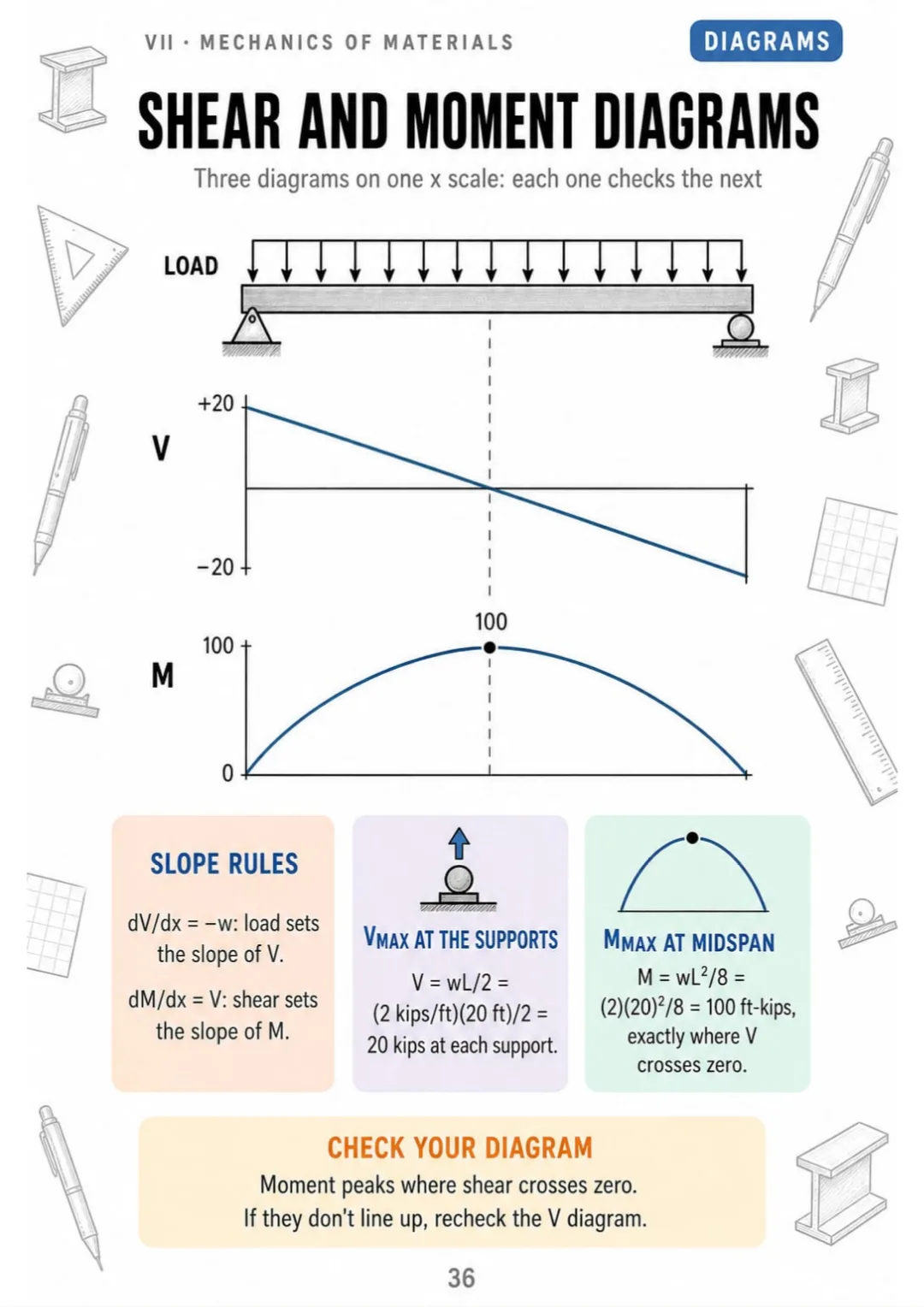
Simple beam, 2 kips/ft over 20 ft: Vmax = 20 kips at the supports, Mmax = 100 ft-kips at midspan.
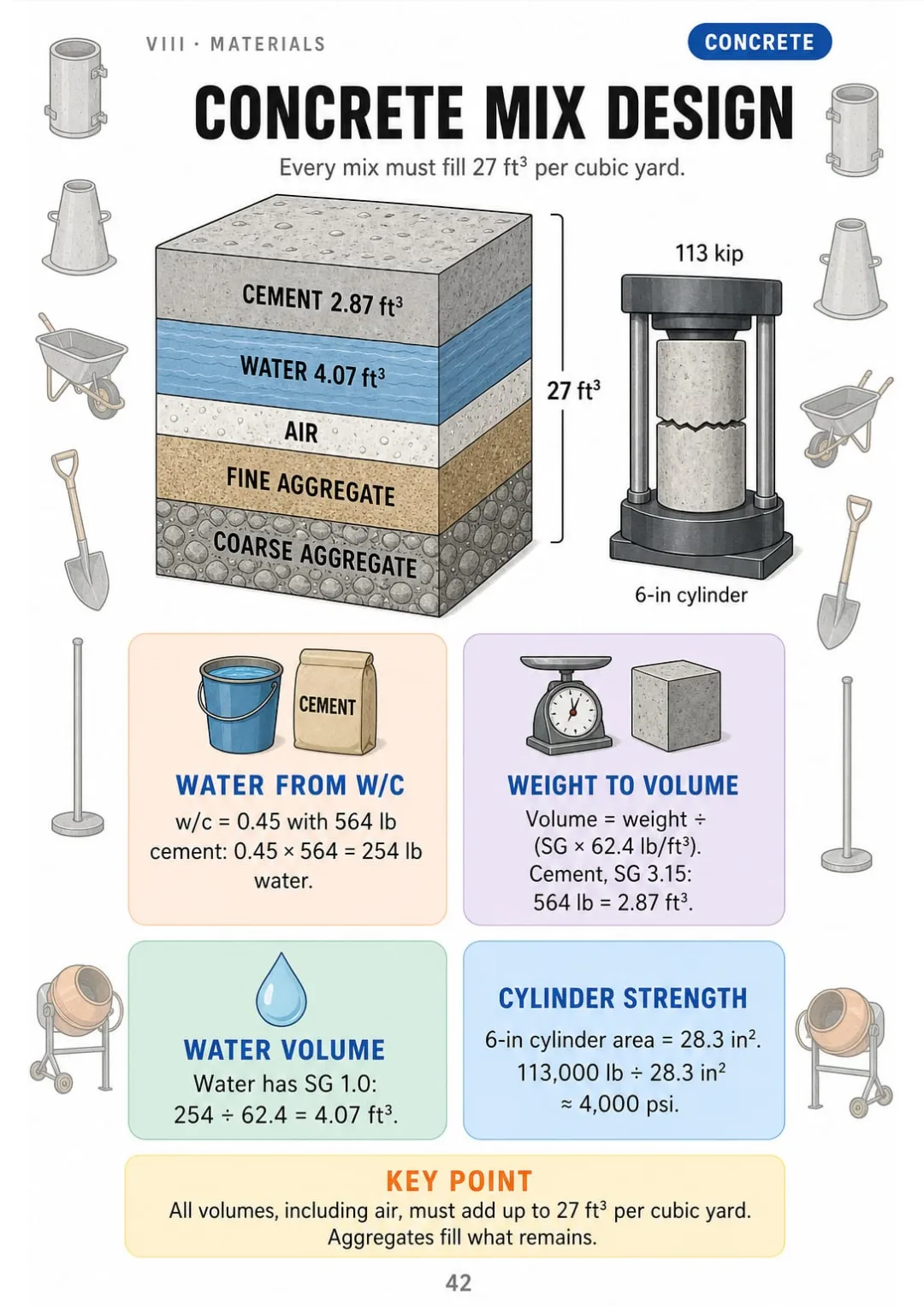
w/c 0.45 with 564 lb cement = 254 lb water: 2.87 ft³ + 4.07 ft³ of the 27 ft³ yard.

Swipe to see more →

These are real pages from the book. The table of contents is the full one: 16 parts and 75 topics.

No One Ever Put It in Order for You.

You've reread the shear and moment chapter three times. You close your notes...

...and you can no longer say why the shear diagram drops or where Mmax lands. It was just lines of text.

Four checks from the NCEES Model Rules, worked on a pressured drawing sign-off.

Here, that beam is one page: 2 kips/ft over 20 ft, with the V and M diagrams lined up under it and Mmax = 100 ft-kips at midspan.

And on the pages around it, each topic has its own: cash flow diagrams, the free-body diagram, ethics, Mohr's circle and the Manning equation.

First you understand why it's done that way. Then the order sticks on its own.

SEE THE DIFFERENCE

Stop Jumping to a Formula Before You've Seen the Problem:

THIS
  • Pages and pages of tightly packed text
  • Formulas without a single drawing
  • On the exam, you don't know where to start
Analytic geometry treats curves through their algebraic equations. The slope of a line through two points is defined as the ratio of the change in the ordinate to the change in the abscissa, and two nonvertical lines are perpendicular when the product of their slopes equals negative one. The general second-degree equation Ax² + Bxy + Cy² + Dx + Ey + F = 0 represents a conic section, classified by the discriminant as an ellipse, parabola or hyperbola, the circle being a special case of the ellipse.
FOR THIS
  • Every topic drawn first, then worked line by line with units
  • One topic per page, with the rules in boxes
  • You remember it because you've seen it
Points (100, 200) and (400, 600) ft: slope 4/3, distance 500 ft, perpendicular slope −3/4.
CONTENTS

Take a Look at the 16 Parts and 75 Topics

The exam and how it works, math and statistics, ethics, engineering economics, statics, dynamics, mechanics of materials, materials, fluid mechanics, surveying, water resources and environmental, structural, geotechnical, transportation, construction, and the final review: 80 pages, all drawn

IThe Exam and How It Works · pp. 6-9
  1. How the FE Civil Exam Is Built
  2. Using the Electronic Reference Handbook Fast
  3. SI and US Customary Units Side by Side
  4. The Step-by-Step Method: Units in Every Line
IIMathematics and Statistics · pp. 10-14
  1. Analytic Geometry: Lines, Circles and Conics
  2. Derivatives as Slopes, Integrals as Areas
  3. Vector Operations: Dot and Cross Product
  4. Mean, Median, Mode and Standard Deviation
  5. Distributions, Confidence Intervals and Regression
IIIEthics and Professional Practice · pp. 15-17
  1. Codes of Ethics and the Public's Safety
  2. Professional Liability and Contracts
  3. Licensure: From the FE Toward the PE
IVEngineering Economics · pp. 18-23
  1. Cash Flow Diagrams
  2. Equivalence: The P, F and A Factors
  3. Present Worth and Annual Worth
  4. Rate of Return and Benefit-Cost
  5. Break-Even, Sunk and Incremental Costs
  6. Uncertainty and Expected Value
VStatics · pp. 24-31
  1. Resultants of Force Systems
  2. Moments and Equivalent Force Systems
  3. Equilibrium and the Free-Body Diagram
  4. Trusses: Method of Joints
  5. Trusses: Method of Sections
  6. Centroid of Composite Areas
  7. Area Moment of Inertia and the Parallel-Axis Theorem
  8. Static Friction
VIDynamics · pp. 32-35
  1. Kinematics: Constant Acceleration
  2. Projectile Motion
  3. Force and Acceleration
  4. Work, Energy and Power
VIIMechanics of Materials · pp. 36-41
  1. Shear and Moment Diagrams
  2. Axial Stress and Strain
  3. Torsion of Circular Shafts
  4. Bending Stress
  5. Combined Stresses and Mohr's Circle
  6. Thermal Stress and Strain
VIIIMaterials · pp. 42-44
  1. Concrete Mix Design
  2. The Stress-Strain Curve of Steel
  3. Test Methods for Aggregates, Asphalt and Wood
IXFluid Mechanics · pp. 45-48
  1. Fluid Properties
  2. Hydrostatic Pressure and Force on a Surface
  3. Continuity and Bernoulli
  4. Flow Measurement
XSurveying · pp. 49-52
  1. Angles, Distances and Trigonometry
  2. Area by Coordinates
  3. Earthwork Volumes
  4. Leveling: Differential Levels and Grades
XIWater Resources and Environmental Engineering · pp. 53-58
  1. Hydrology: Runoff and the Rational Method
  2. Open-Channel Flow and the Manning Equation
  3. Pipe Flow and Pumps
  4. Water Distribution Systems
  5. Groundwater: Darcy's Law and Wells
  6. Water Quality and Treatment
XIIStructural Engineering · pp. 59-64
  1. Beam Reactions and Statically Determinate Beams
  2. Beam Deflection
  3. Column Buckling: Euler's Formula
  4. Loads, Load Combinations and Tributary Areas
  5. Steel Design Basics
  6. Reinforced Concrete Beam Basics
XIIIGeotechnical Engineering · pp. 65-69
  1. Phase Relations: Air, Water and Solid
  2. Index Properties and Soil Classification
  3. Effective Stress
  4. Bearing Capacity and Retaining Walls
  5. Consolidation and Settlement
XIVTransportation Engineering · pp. 70-73
  1. Horizontal Curves
  2. Vertical Curves
  3. Traffic Capacity and Flow
  4. Pavement Design Basics
XVConstruction Engineering · pp. 74-77
  1. Scheduling: Critical Path Method
  2. Earned Value
  3. Construction Estimating
  4. Reading Engineering Drawings
XVIFinal Review and Exam Day · pp. 78-80
  1. Look-Alike Formulas, Side by Side
  2. The Most Frequent Mix-Ups
  3. Exam Day Checklist

What If Every Topic Fit on a Single Page?

Picture this:

Instead of rereading half a page on shear and moment without being able to see it...

...you open the page and find the beam, the load and the V and M diagrams lined up beneath it, with Vmax and Mmax marked.

300 lbf east + 400 lbf north = 500-lbf resultant at 53.1° from east.

And cash flows, trusses, effective stress, open-channel flow and vertical curves turn into drawings and tables you can read at a glance.

You stop memorizing and start understanding.

That's exactly what The FE Civil Exam Sketchbook does. It's not “just another manual.” It's 16 parts and 75 drawn topics, and at the end the look-alike formulas side by side, the most frequent mix-ups and an exam day checklist.

Because what your brain sees organized, it remembers.

Here Is What You Get with The FE Civil Exam Sketchbook:

Ipp. 6-9

The Exam and How It Works

How the exam is built, the electronic Reference Handbook, SI and US customary units side by side, and the step-by-step method with units in every line.

IIpp. 10-14

Mathematics and Statistics

Lines, circles and conics, derivatives and integrals, dot and cross products, and statistics from the mean to regression.

IIIpp. 15-17

Ethics and Professional Practice

Codes of ethics and the public's safety, liability and contracts, and licensure from the FE toward the PE.

IVpp. 18-23

Engineering Economics

Cash flow diagrams, the P, F and A factors, present and annual worth, rate of return, benefit-cost, break-even and expected value.

Vpp. 24-31

Statics

Draw the free-body diagram before you calculate: resultants, moments, equilibrium, trusses by joints and by sections, centroids, moment of inertia and friction.

VIpp. 32-35

Dynamics

Constant acceleration, projectile motion, force and acceleration, and work, energy and power.

VIIpp. 36-41

Mechanics of Materials

See where shear and moment peak on the beam: shear and moment diagrams, axial stress and strain, torsion, bending stress, Mohr's circle and thermal stress.

VIIIpp. 42-44

Materials

Concrete mix design, the stress-strain curve of steel, and test methods for aggregates, asphalt and wood.

IXpp. 45-48

Fluid Mechanics

Fluid properties, hydrostatic pressure and force, continuity and Bernoulli, and flow measurement.

Xpp. 49-52

Surveying

Angles and distances, area by coordinates, earthwork volumes and differential leveling.

XIpp. 53-58

Water Resources and Environmental Engineering

Follow the water from runoff to the well: the Rational Method, Manning, pipe flow and pumps, distribution systems, Darcy's law and water quality.

XIIpp. 59-64

Structural Engineering

Beam reactions and deflection, Euler buckling, loads and tributary areas, and the basics of steel and reinforced concrete.

XIIIpp. 65-69

Geotechnical Engineering

Phase relations, soil classification, effective stress, bearing capacity, retaining walls, consolidation and settlement.

XIVpp. 70-73

Transportation Engineering

Horizontal and vertical curves, traffic capacity and flow, and pavement design basics.

XVpp. 74-77

Construction Engineering

Critical path scheduling, earned value, estimating and reading engineering drawings.

XVIpp. 78-80

Final Review and Exam Day

Look-alike formulas side by side, the most frequent mix-ups and an exam day checklist.

At the end of the book: Look-alike formulas side by side, the most frequent mix-ups and an exam day checklist.
And That Is Not All: 2 More Books, Free

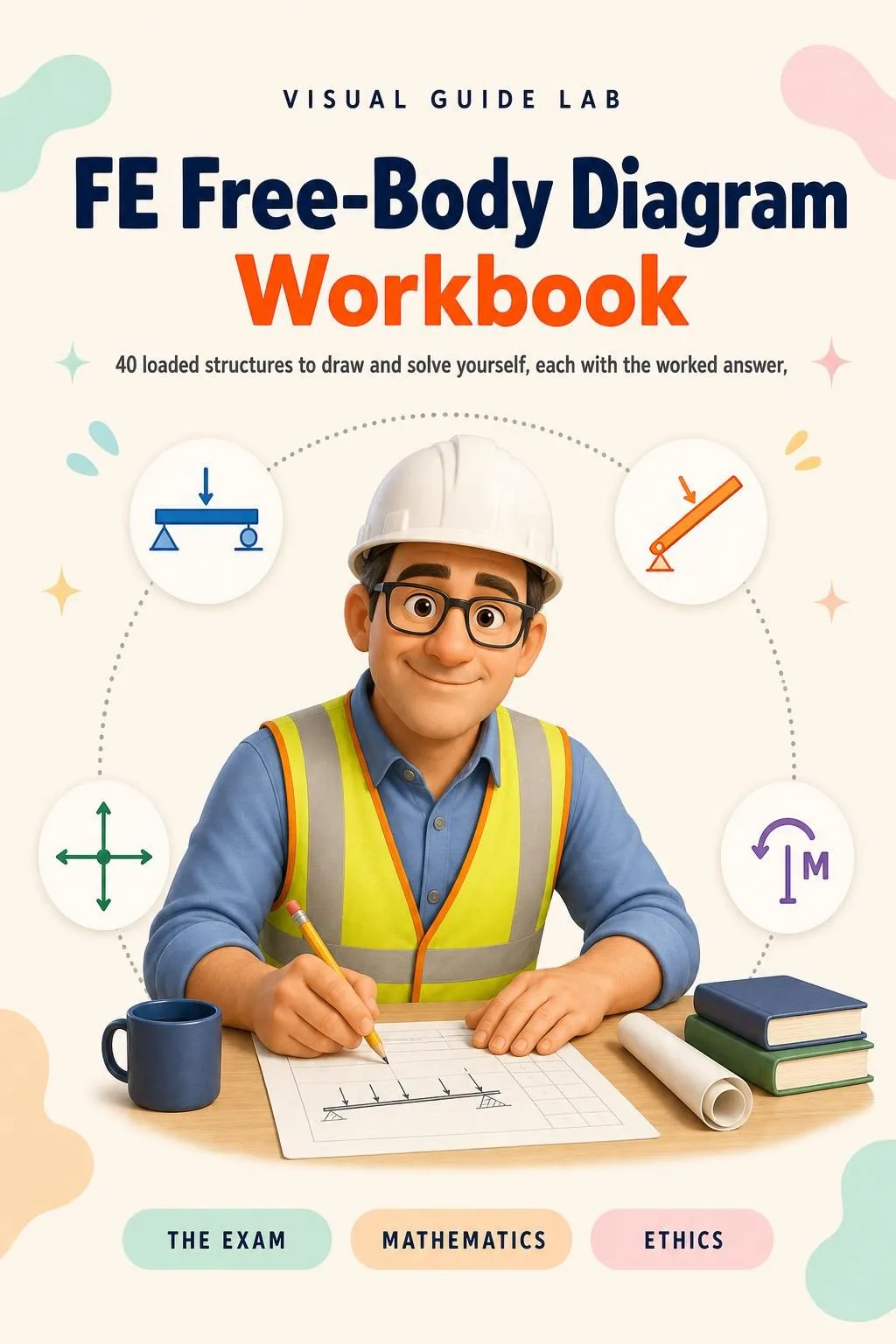
FE Free-Body Diagram Workbook

BONUS 1: «FE Free-Body Diagram Workbook»

Value on its own: US$ 17.90

40 loaded structures to draw and solve yourself, each with the worked answer, so you can check your diagram and your equations.

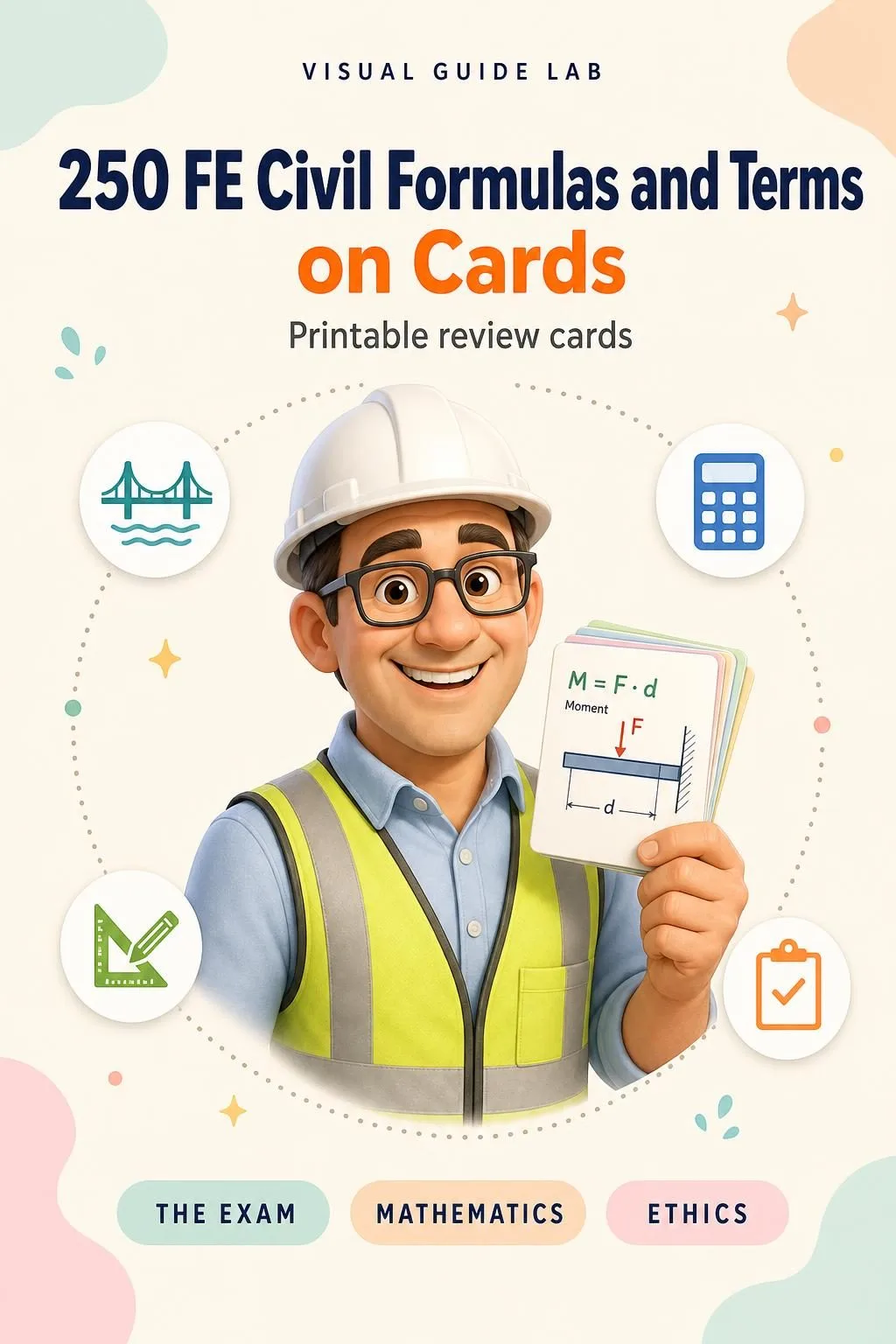
250 FE Civil Formulas and Terms on Cards

BONUS 2: «250 FE Civil Formulas and Terms on Cards»

Value on its own: US$ 14.90

Printable review cards: the term or formula on the front, its variables, units and a tiny sketch on the back.

The FE Civil Exam Sketchbook + 2 Free Books

  • The FE Civil Exam Sketchbook: 80 drawn pagesUS$ 63
  • BONUS 1: FE Free-Body Diagram WorkbookUS$ 17.90
  • BONUS 2: 250 FE Civil Formulas and Terms on CardsUS$ 14.90
  • High-resolution PDF to printIncluded
Total value US$ 95.80
YOUR PRICE:
US$ 27
You save US$ 68.80
YES, I WANT THE FE CIVIL EXAM SKETCHBOOK FOR US$ 27

📄 This is a digital PDF book sent to your email: nothing is printed or shipped.

Secure purchaseEncrypted payment30-day guarantee

PDF by email: The FE Civil Exam Sketchbook reaches your inbox as a PDF, and the two free books come by email too. One-time payment, no installments or hidden costs.

Is This Book for You?

You're finishing your civil degree

You're finishing your civil degree

Statics, mechanics of materials, fluids and soils, one topic per page, to review between classes and draw before you calculate.

Your FE Civil date is getting close

Your FE Civil date is getting close

A review of all 14 knowledge areas, and at the end the look-alike formulas side by side and an exam day checklist. If you're retaking it, your diagnostic report tells you which pages to open first.

You graduated years ago and you're working

You graduated years ago and you're working

You know the job. The book brings back beams, Mohr's circle and the economics factors, with the drawing and the full calculation, units in every line.

To Sum Up: Here Is What You Get

US$ 95.80US$ 27
YES, I WANT THE FE CIVIL EXAM SKETCHBOOK FOR US$ 27

📄 This is a digital PDF book sent to your email: nothing is printed or shipped.

30DAYS
GUARANTEE

30-Day Guarantee

30-day guarantee: tell us what didn't work and we'll refund 100%.

You have 30 days to try The FE Civil Exam Sketchbook and the two bonus books. If it doesn't work for you, tell us what didn't work and we'll refund 100% of what you paid. One-time payment, no subscriptions and no surprises.

Frequently Asked Questions

How do I get the material?

PDF by email, sent to the address you enter at checkout. The two bonus books, FE Free-Body Diagram Workbook and 250 FE Civil Formulas and Terms on Cards, also come as PDFs by email.

Is the payment monthly or one-time?

One-time payment of $27. No installments and no subscription.

Who is it for?

Anyone preparing for the FE Civil exam in the US: final-year students, recent graduates, and people who graduated years ago and are taking or retaking it. It's a review, not a first course: it assumes you've taken, or are taking, the engineering classes. It covers FE Civil only, not other FE disciplines or the PE. Check the index above to see the topics.

What is it based on, and what does it add if I already have the Handbook?

The NCEES FE Civil CBT exam specification, which sets the 14 knowledge areas, and the NCEES FE Reference Handbook. This edition follows the specification effective July 2020: you can compare it with the current one on ncees.org before you buy. The book doesn't reproduce the handbook: it shows you how to find what you need in it and use it, with the drawing and the full calculation.

Is this official material?

No. It's independent study material, not affiliated with or endorsed by NCEES or any state licensing board.

Does it replace a prep course or my degree?

No. It's a study guide. It doesn't replace your engineering education, a prep course or the Reference Handbook, it doesn't grant a license, and it isn't design advice. No book can guarantee an exam result, and this one doesn't either.

Are the practice problems the ones on the exam?

No. Every worked example and exercise is written for this book. They aren't official questions or copied exam items: they're there for practice. The book isn't a full-length practice exam.

Can I print it?

Yes. It's a PDF: read it on your phone, print all of it, or print only the pages you need. It's for studying: on exam day you work with the electronic Reference Handbook provided during the exam.

What if I don't like it?

30-day guarantee: tell us what didn't work and we'll refund 100%.

One Last Thing Before You Decide...

You don't have to reread the same page hoping it sticks this time.

You don't have to search the Handbook for a formula before you've even drawn the problem.

And you certainly don't have to walk into the exam not knowing where to start.

You already have the Handbook, the notes and the videos. What's missing is one order to follow: 80 drawn pages, one topic per page, plus 2 free books. PDF by email, with a 30-day guarantee.

One-time payment: US$ 27 · Guarantee: 30 days · PDF by email

YES, I WANT THE FE CIVIL EXAM SKETCHBOOK FOR US$ 27

📄 This is a digital PDF book sent to your email: nothing is printed or shipped.